Polyurethane for High-Speed Applications
Quick Summary
- High-speed applications place unique demands on polyurethane wheels and rollers.
- Low rolling resistance is often the most critical material property in high-speed environments.
- Dynamic load capacity, resilience and compression set resistance play a major role in performance and lifetime.
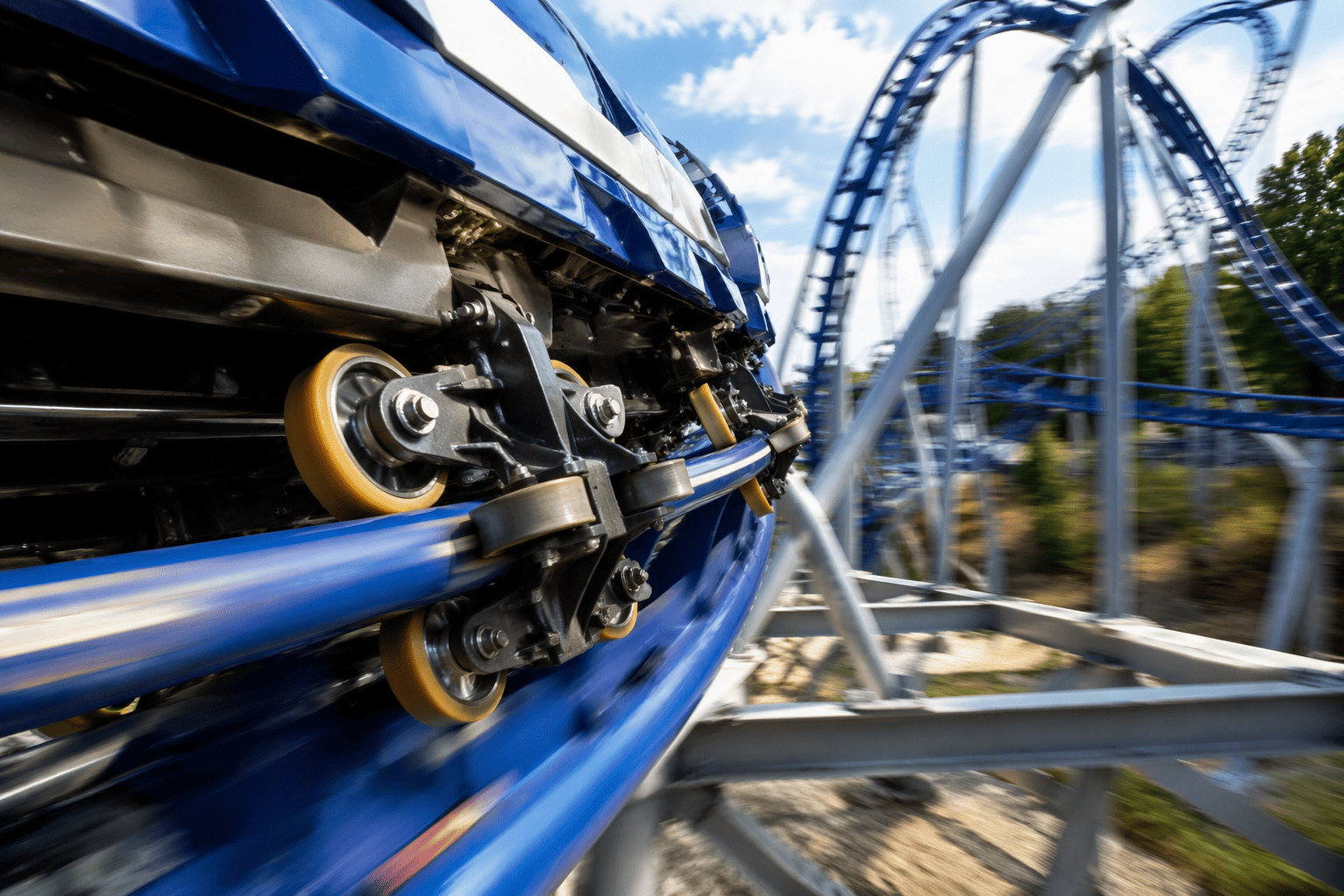
- Roller coaster rides are among the most demanding high-speed polyurethane applications.
- Selecting the correct polyurethane grade can significantly improve reliability, performance and component lifetime.
What Is Considered a High-Speed Application?
High-speed polyurethane applications can be found across a wide range of industries.
High-speed applications are not defined by speed alone. They often combine high speeds with dynamic loads, continuous operation and demanding environmental conditions.
Examples include:
- Roller coasters
- High-speed transportation systems
- Automated logistics systems
- Industrial equipment operating at high rotational speeds
While roller coasters are one of the most demanding examples, other high-speed applications also require carefully engineered polyurethane solutions.
Examples of High-Speed Applications
| Application | Key Material Requirements |
|---|---|
Roller coaster rides |
Low rolling resistance, high dynamic load capacity, wear resistance, heat resistance, water resistance |
Transportation systems |
Load capacity, low rolling resistance, durability, reliability, torque resistance |
Intralogistics systems |
Load capacity, low rolling resistance, durability and reliability |
High-speed manufacturing equipment |
Heat resistance, wear resistance, dimensional stability |
Although these applications differ significantly, they share a common challenge: maintaining reliable performance under high speeds, dynamic loads and continuous operation.
Why Are High-Speed Applications More Demanding?
As operating speed increases, polyurethane components are exposed to:
- Higher dynamic loads
- Increased heat generation
- More frequent loading
- Increased wear
- Greater sensitivity to rolling resistance
These factors can significantly influence performance, efficiency and lifetime.
A material that performs well at moderate speeds may not necessarily perform well under demanding high-speed conditions.
Key Requirements for High-Speed Polyurethane Applications
| Requirement | Why It Matters |
|---|---|
Low rolling resistance |
Reduces heat build-up and energy loss |
Dynamic load capacity |
Maintains performance under repeated high loads |
Resilience |
Allows the material to recover quickly under dynamic loads |
Compression set |
Prevents permanent deformation over time |
Heat resistance |
Maintains performance at elevated temperatures |
Wear resistance |
Extends component lifetime |
Low Rolling Resistance
For many high-speed applications, rolling resistance is the most important material property.
Rolling resistance directly affects:
- Energy consumption
- Heat generation
- Dynamic performance
Excessive rolling resistance can lead to increased temperatures, reduced efficiency, shortened component lifetime and, in some cases, sudden wheel failures.
In non-driven wheel applications, high rolling resistance can also reduce operating speeds. In extreme cases, such as roller coaster rides, excessive rolling resistance can even prevent the train from completing the cycle as intended.
Dynamic Load Capacity
High-speed applications often involve continuous acceleration, deceleration and changing loads.
Polyurethane materials must be capable of maintaining performance under these demanding dynamic conditions.
Resilience and Compression Set
Resilience describes how effectively a material can recover after deformation.
A low compression set helps prevent permanent deformation during long-term operation.
For wheels, a high compression set can also lead to the formation of flat spots when equipment or vehicles remain stationary for extended periods.
Both properties become increasingly important as speed and loading cycles increase.
Heat Resistance
Heat is one of the biggest challenges in high-speed applications
There are two main causes of high wheel temperature. The first is the environmental temperature in which the application operates. The second is the heat generated within the polyurethane material itself as a result of rolling resistance and continuous dynamic loading.
As speed increases, internal heat build-up can significantly influence material performance and lifetime. The material must be able to retain its mechanical properties even when operating temperatures rise.
For this reason, heat resistance and low rolling resistance often go hand in hand in demanding high-speed applications.
Wear Resistance
Higher speeds generally result in more distance travelled and greater wear.
Selecting a polyurethane material with excellent wear resistance can significantly extend service life.
Roller Coaster Wheels: One of the Most Demanding High-Speed Applications
Roller coaster wheels are among the most demanding high-speed polyurethane applications.
Unlike many other high-speed applications, roller coaster wheels combine:
- High speeds
- High (impact) loads
- Repeated dynamic loading
- Challenging environmental conditions
Typical requirements include:
- High load-bearing capacity
- Low rolling resistance
- High wear resistance
- Heat resistance
- Consistent performance under dynamic loads
Not every polyurethane grade is suitable for these conditions.
Interestingly, even higher-speed applications exist, such as certain Hyperloop projects. However, these typically operate under lower loads and more moderate conditions than roller coaster wheels.
Polyurethane materials are available in many different formulations.
The optimal material depends on:
- Speed
- Load
- Temperature
- Rolling resistance requirements
- Driven or non-driven operation
- Lifetime expectations
Selecting the correct material can significantly increase reliability and reduce wear, downtime and maintenance costs.
How LUC Group Supports High-Speed Applications
At LUC Group, material selection is based on the specific operating conditions of the application.
Parameters such as load, speed, temperature, rolling resistance requirements, driven or non-driven operation, and expected lifetime are evaluated to select the most suitable polyurethane material.
In addition to material expertise, LUC Group makes use of a dedicated wheel testing system to evaluate wheel performance under realistic operating conditions. This helps to assess factors such as rolling resistance, durability and overall performance in demanding high-speed applications.
With more than 500 polyurethane material grades available, solutions can be tailored to demanding high-speed applications.
LUC Group supports customers in selecting materials optimized for dynamic loads, rolling resistance, heat generation and long-term performance.