Where Engineering Precision Meets Ocean Power
Offshore operations demand absolute confidence. When massive components travel across open seas—monopiles, heavy equipment, or specialized offshore structures—the forces acting on them are extreme. Wind, waves, vessel motion, and dynamic load cycles all create challenges that must be met with high‑performance engineering solutions.
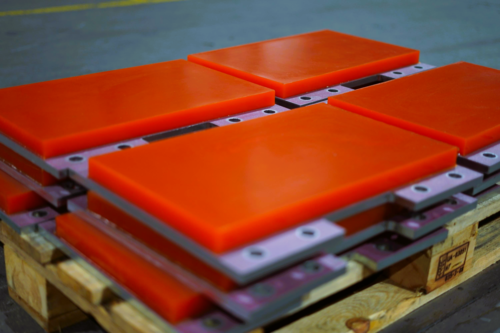
High‑Friction PU Pads are one of the unseen heroes in this process: compact, engineered, and essential for safe seafastening. They ensure that cargo remains secure, stable, and protected throughout offshore transport—no matter the conditions.
The Purpose of High‑Friction PU Pads
During offshore transport, the interface between steel structures and support frames must remain reliable under dynamic loads. High‑Friction PU Pads provide:
- Exceptional grip to prevent cargo movement
- Controlled deformation that compensates for tolerances
- Load distribution to protect both cargo and support structures
- Surface protection to avoid coating damage
- Consistent friction performance in harsh environments
Their purpose is simple: keep heavy components secure while absorbing the realities of offshore motion.
Material Excellence: What Makes PU Ideal for Offshore?
Polyurethane (PU) is an outstanding material for offshore conditions due to its:
- High dynamic load‑bearing capability
- Strong wear and abrasion resistance
- Ability to achieve high friction levels
- Resistance to saltwater, temperature variations, and humidity
- Flexibility in shaping and embedding into seafastening designs
This combination makes PU ideal for pads used in marine, offshore, and heavy‑transport operations.
When Engineering Meets Harsh Seas
Offshore transport exposes cargo to:
- Roll and pitch forces
- Vessel acceleration
- Slamming loads
- Vibrations
- Long duration fatigue cycles
In such environments, friction pads must not only hold a monopile or structure in place—they must maintain performance throughout the entire voyage, even under unpredictable weather dynamics. High‑Friction PU Pads absorb micro‑movement, spread load, minimize wear, and prevent coating damage—critical for ensuring structural integrity upon arrival.
Spotlight Application: Monopile Transport
Monopiles used in offshore wind foundations are among the largest structures ever transported by sea. Typical dimensions can include:
- Diameters exceeding 9 meters
- Lengths over 70 meters
- Transport weights well above 1,300 tons
With components of this scale, the interface material plays a critical role. High‑Friction PU Pads:
- Secure cylindrical monopiles in cradle structures
- Protect painted surfaces from damage
- Increase friction to prevent rolling or shifting
- Absorb load variations caused by vessel motion
- Ensure stable, predictable contact under massive weight
Their performance directly contributes to safe, efficient, and damage‑free monopile delivery.
Quality You Can Depend On
At LUC Group, each pad undergoes a rigorous production and finishing process that includes:
- Hardness verification
- Bond quality inspection
- Curing control
- Visual and dimensional checks
- Final mechanical performance evaluation
This ensures every pad meets offshore‑grade performance requirements—reliable, stable, and capable of handling extreme loads.
Versatile Across Offshore Applications
Beyond monopiles, High‑Friction PU Pads are widely used for:
- Seafastening of general offshore structures
- Transport frames for heavy equipment
- Upending and support tools
- Temporary fixing systems
- Heavy cargo stabilization on deck
Their adaptability and durability make them a trusted solution across the offshore energy and marine sectors.
A Small Component With Massive Impact
High‑Friction PU Pads may appear modest in size, but their contribution to offshore safety and reliability is significant. They combine material science, precision engineering, and offshore resilience—working quietly behind the scenes to ensure every journey across the sea is safe, stable, and predictable.