Polyurethane or rubber?
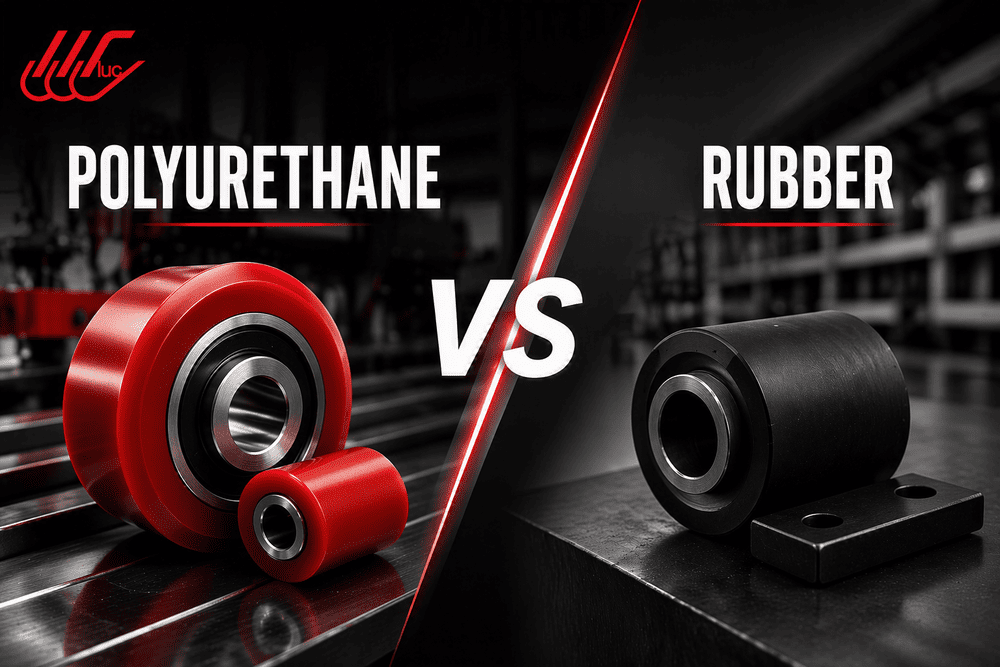
Quick Summary
- Polyurethane combines strength and elasticity, making it suitable for demanding applications
- Compared to rubber, it typically offers higher wear resistance and longer lifetime
- Rubber is still widely used, not only due to cost, but also because it has traditionally been the standard material and alternatives are not always considered
- LUC Group develops custom polyurethane solutions tailored to industrial needs
Polyurethane vs Rubber: What’s the Difference?
Polyurethane and rubber are both elastomer materials commonly used in industrial applications.
However, polyurethane elastomers combine the elasticity of rubber with the strength of plastic, resulting in significantly improved performance in many demanding environments.
This is why polyurethane is often preferred over traditional rubber in high-performance applications.
It is important to note that both polyurethane and rubber are available in a wide range of different compounds, each with its own specific properties. The performance of each material depends on the exact formulation used and the requirements of the application.
Key Differences Between Polyurethane and Rubber
| Property | Polyurethane | Rubber |
|---|---|---|
Wear resistance |
Very high |
Moderate |
Load capacity |
High |
Moderate |
Durability |
Long lifetime |
Shorter lifetime |
Customization |
Highly customizable |
Limited |
Performance under stress |
Excellent |
Good |
UV resistance |
Very good |
Poor |
Chemical resistance |
Good |
Good |
Temperature resistance |
Good |
Good |
Surface marking |
Non-marking |
Marking |
Why Polyurethane Outperforms Rubber in Many Applications
- Superior Wear Resistance
Polyurethane performs significantly better in environments with friction, abrasion, and continuous use, especially if loads are high.
This results in:
- Longer component lifetime
- Reduced replacement frequency
- Higher Load-Bearing Capacity
Polyurethane can handle both static and dynamic loads, making it ideal for industrial machinery and transport systems.
Rubber, on the other hand, may perform less under heavy loads.
- Better Performance in Harsh Environments
Certain polyurethane grades are designed to withstand:
- Chemicals
- Oils
- High friction
At LUC, specialized materials such as LUCTEC and LUCHYD are developed for exactly these types of conditions, outperforming rubbers in many applications.
- Custom Material Solutions
A major advantage of polyurethane is its flexibility in formulation, even for small volumes.
At LUC:
- Over 500 material grades are available
- Each material is selected based on the application
- Performance can be optimized for specific industries
This is not possible with standard rubber materials.
When is Rubber Still Used?
Although polyurethane offers many advantages, rubber is still used in certain applications.
Rubber may be preferred when:
- Cost is the main factor
- The application is less demanding
- High performance is not required
In these cases, rubber can be a practical and economical choice.
In these cases, rubber can be a practical and economical choice, but it is also often selected because it has traditionally been used and alternative solutions are not always considered.
Industrial Applications: Polyurethane vs Rubber
Polyurethane is widely used in:
- Rollers for steel and aluminium rolling mills and processing lines
- Wheels for logistics systems
- Offshore installation equipment
- Amusement ride components (e.g. roller coaster wheels)
- Food processing equipment
These applications require:
- High durability
- Continuous performance
- Resistance to wear and load
- Resistance to harsh environmental conditions
Rubber is typically still used in:
- Pneumatic tyres
- Basic seals and gaskets
- Dampers
- Low-cost conveyor rollers
Why Companies Switch from Rubber to Polyurethane
Many companies replace rubber with polyurethane to improve performance.
Main reasons include:
✅ Longer lifetime
✅ Reduced maintenance
✅ Improved system efficiency
✅ Extended (technical) possibilities
✅ Lower total cost over time
At LUC, this is directly linked to the concept of Total Cost of Ownership, where higher-quality materials reduce downtime and operational costs.
Why Custom Polyurethane Matters
Not all polyurethane is the same.
At LUC:
- Every solution is custom-made
- Materials are selected based on:
- Load and performance requirements
- Environmental conditions
- Application-specific challenges
This ensures optimal performance and reliability.
In addition, for moulded parts, polyurethane can also offer advantages such as lower tooling costs compared to rubber, as well as faster production times for smaller series.


LUC Group supports customers in selecting and developing the right polyurethane material for their application — improving performance and reducing long-term costs.